Showing posts with label physics. Show all posts

16 October 2009

interaction/particle groups in a math object context

27.x.XXX


This graph shows a few of the groups describing particle families based on fundamental interaction (force) fields in which they figure as gauge particle, or field generator / interactors (eg, the standard model aiming to include all particles, involves the cross product of three groups - for three fundamental interactions - note there is none for gravity, as no particle for it is yet known :)), in relation to other mathematical objects, including finite automata (computers).


It is reproduced from this earlier post. Made using Graphviz/2.22 :)

###

... Read more

30 September 2009

life and the law of inertia

11.X.MCDXXX


Does life violate Newton's first law of motion (Galileo's law of inertia) or does it merely channel / divide and redirect ancient forces from the beginning of the world.

Although the discussion turns out to be vacuous and circular, there are arguments in favor of both cases - until further more level-headed inquiry.

the wikipedia version of the law will do for now
* An object that is not moving will not move until a net force acts upon it.
* An object that is moving will not change its velocity until a net force acts upon it.

Yet living organisms, for example ourselves, being autonomous, move and change their own velocities not due to external net forces but all by themselves.

the law does not account for the force that moves a living being. it moves itself by its own volition.

The immediate cause of the movement is the actuation of muscle states by nerve signals. Preceding the onset of this process, however, What triggers this actuation?

In our case it is easy to say, thought. In the case of unicellular and other protista, some will cite changes in chemical concentration affecting sequences of stimulus-response mechanisms.

thought. it is here the force concept breaks down or seems to, because the signals originate as response to other sensory signals, none of them explaining the voluntary work done to lift a quadruped or biped up from the ground, and the forces that move their limbs.


But thought is not accountable as a net external force on the human body.

Nowhere in the law of inertia (newton's first law) does it say that a human or a living thing will accelerate itself (ie, change its own velocity).

According to this tiny piece of physics, we should not move at all, unless physically pushed - from the outside. But typically we push ourselves. We spend some energy to exert a force that was not there. We move where no motion would have been predicted by pure physics.

it's likely i'm missing a glaringly obvious detail. So it's better to start with such a criticism. This could be in the words "we spend some energy to exert a force"; so in the long view, one could say energy turned into a force that moved that individual.

this makes us energy transformers. we collect energy, then use it to exert forces that move us as well as other things.

in this sense we are much like, and are literally automobiles.

for energy is stored and converted into force (with much release of hea) to achieve motion - at will.

this sequence of forces can be traced - along the question "but what moved us" - all the way back to the first cell of life. but still, what moved it? still one can trace this back to all the forces that led to the chemical agglomeration of the first proteins and organelles.

so forces dating back billions of years led to life which stores energy and then take it and convert it into force at will whenever it moves itself or something else.

This can only be as useful as the dependence of the 2nd law of motion on it.

... Read more

fields or the society of matter

11.X.MCDXXX


Fields are not the only way to describe systems at the level of the fundamental interactions.

Fields for as long as i remember offer the most straightforward , the only way to describe the fundamental forces of nature.

On the other hand as an earlier post pointed out in a conjecture about social fields, some of the same ideas could be applied to the study of human interactions in social settings (unverified). e.g., each person emits certain types of fields, and the interactions among those fields define the kind of social behavior of people.

this could be studied using wave functions on the macro level for an entirely new set of "gauge" charges, reflecting typical social factors - eg psychological, cultural economic and political - that define social behavior, and also factors atypical for social sciences, like spirituality.

when studying particle systems, could there be similar high level descriptions?

as an example, one of the most popular abstractions of the past century is group theory based entirely on transformations. It is a classification of things by the types of transformations they can undergo (they admit).

These proved to be the primitives from which the different states can be constructed to describe the properties of different particles - mass; quantum numbers like the spin which reflects its magnetic field strength and direction (moment); angular momenta and flavors like the e- charge. thus in large part, the field mechanical formalism is a group theoretic one.

So what other higher level concepts - if any - can be identified and applied to the study of systems of particles interacting in the fundamental fields, other than the field formalisms?

one of the encouraging indications about this line of thought is that it is currently laughable - too laughable to bring up in sci'fic company.

This graph shows a few of the groups describing particle families based on fundamental interaction (force) fields in which they figure as gauge particle, or field generator / interactors (eg, the standard model aiming to include all particles, involves the cross product of three groups - for three fundamental interactions - note there is none for gravity, as no particle for it is yet known :)), in relation to other mathematical objects, including finite automata (computers).

It is reproduced from this earlier post. Made using Graphviz/2.22 :)

... Read more

19 September 2009

dephase for negative mass?

29.Ix.MCDXXX


dephasing could lead to (not negative mass so much as) a reversal of the sign of the mass / energy scalar (of a system? "of a system" is greatly desired, ie described formally in a coord system)

dephasing could mean producing two opposite states possibly by disentangling an intermediate state
between two opposites - an invisible or imperceivable balance/equilibrium state - into the component states by separating the time-dependent streams/sequences of component states.

opposing states could be embodied in dipolar patterns in nature (physical and cognitive) - the dichotomy pattern

artifacts like dichotomies and particularly this scalar sign reversal which has no meaning in physics aren't so nonsensical when the world is indistinguihsable from a mathematical description or image (a symbological or cognitive construct). in other words, negative mass is not impossible if the world is contingent on a logical formalism like our mathematics.

The de-phasing is only one kind of any possible transformations of a system that we can find that lead to a reversal of the energy scalar sign.

... Read more

17 September 2009

social fields

27.ramadan.MCDXXX


updated version of an earlier post with some additions.

*
we imagine a human society where each individual is a generator of at least one field, or is the gauge particle of a field
*
likewise we can imagine the individual comprised a bunch of gauge charges (flavors) each interacting / generating different fields - just like a particle could interact strongly, e-weakly and gravitationally

*
or rather that every individ is both a gauge particle generating a field, and endowed with different charges , "observables that interact with other particles field
* different ways to conjecture:
-- the individuals are each unique , unlike the particles families in the physical metaphor or source of the analog we're trying to construct. conversely,
-- not unlike individual particle instances of a given class of particles, the invidivual's are identical - eg, "a single soul", and a "single Self" - and thus conform in their various properties, particularly their gauge charge. this is even more attractive than the first conjecture

*
counterconjecture: not unlike physical particles, individs represent instances of different classes / families of particles (having nothing to do necessarilty with biological kinship)
*
each individual generates a field of influence in its neighborhood
*
others are either outside the field or inside, or the field could be infinite tapring off to infinitesimality in the case of people who do not know the individual and who might subissent a residual influence that is negligible not , felt.
*
those that are closer to the indvid who generates his field, have a larger charge wrt to the charge field generated by the individ than others.
*
this determines their proximity or distance to him in his field - which socially translates to the group of people interacting directly with the individ.

*
what kind of topological space would correspond to the set of individuals in a society?
o
how connected, compact, and separable is that topological space?
o
what kind as in how is it to be classified? t0, t1, t2, t2.5, t3, t3.5 , t4, t5, t6,
+
hausdorff, normal, regular, tychonoff, etc.
o
we note that the intersections of neighborhoods are not empty, as one clue to the type of topology of the social spc

*
we let state be the open/closed / clopen sets that constitute the (local) neighborhood of each individ in the social set or space
o
there may be a prblm w/ that def

*
we image that transformations are changes of state for a given subset S of the spc
o
if the change of state is generated from S (self-generated) ,
+
the xform is an automorphism?
+
equiv to action by the subset?
o
if the change is generated by another subset R , it is a xform R→S or is it?
o
it is not
o
we cannot change a subset R to subset S , we cannot transorm people into other people
o
the changes are from state(t1) to state(t2),
o
thus it seems the change is from a subset to a subset hence always an automorphism
o
on the other hand individs may move from one subset to another in the course of / due to a xformat ,thus
+
was the xform applied to single subset ending up affecting more than just that subst or
+
was the xformat applied to all the subsets that got affected?

*
thus there may be two prblms w/ xformats
o
in defining what is a state
o
in defining what is a transformation (of what, what changes what remains the same, from what to what,automorph or not)

*
motivation for social xforms:
o
ideally that would be to look at em in terms of groups, the study of which properties are useful to descriptions (and verifiable sims) of the system
o
but since a) i know neither what it means to organize xforms into groups , nor what the props o groups and their representations, their lie algs and their lie algebras' reps say about the system or the xformats; and b) i am in the effort to understand and know those things
o
this is what the construct of the social field analogy and identifying xformats their groups vis a vis the props / observables and the system.
o
wrk symmetry into that: those xforms that leaves certain props unchanged.


foregoing can thus also relate a bit to an earlier post, I am negative mass.
... Read more

19 July 2009

time bubble note

26.vii.MCDXXX


Like any foam, the bubbles in a time foam would have to be maintained by surface tension. But tension of what surface?

The surface of a time bubble consists of nothing other than regular mass , but controlled in a way , perhaps through intrinsic momenta or angular momenta, so as to create a differential between the rate of time flow inside and outside the bubble.
... Read more

17 May 2009

time, loops and motion

22.V.1430


when dealing with the passing of time in computer programming , there is no recourse like the loop. For instance, how else do we handle the repititiveness of time when doing things like printing a clock update?

programming indefinite timeframe in which to wait and catch events as they occur - involves a loop- like the processing loop.

* But what other loops are there nature? Motions.

* So is time generated by motion? In other words, in the absence of motion, is there no more time?

If Nature is customarily subtle, its signals that this may be true, could not be more blunt. Most of the motions we see are periodic. Indeed are physical and social existence are organized around those loops of time.

Entertaining the blind conjecture that time is loop-like. Recalls familiar notes.

* As we said, motion itself is loop-like due to laws.
* The relation of time to motion and energy is clear from e=mc^2 and e=hυ.
* so (maybe) motion generates time (?)

* iow, time is a function of motion. eg, time is like the displacement over its derivative t(s) = s(t)/s'(t).

* That time, as a function is periodic suggests time is a complex function.

... Read more

things life teaches dept: if the universe were an algorithm

22.V.1430


if the entire universe is an algorithm,
then its entire run and outcome set must be known in advance.

there are good reasons why it is an algorithm, and not only as a collection of cellular automata primitives.

it is an alg, as a process that is controlled by sets of constraints - which are the physical laws.

even for a chaotic process, the constraints of physics , or of nature, apply.

it is an algorithm also in the sense of a dynamic model, we know it is controlled or self-regulating/controlling because the persistence of form of some of its objects , like us, despite a continual flow of matter "through" us. That was pointed out by Wiener in Cybernetics

Since a state function is defined (even if it is unknown) by the domain/range, and because a process itself is a set of state or transitions functions, it mus be viewed as a design, ie no different from other state transition machines, or state machines, or automata - save in complexity of course.

The implication is clear. As an algorithm, a formal (vs. natural) automatic machine, it is designed and like any well-designed system, its behavior and outcomes must have been anticipated and fully understood before its "deployment" :)


... Read more

05 March 2009

i am negative mass - socially

08.iiI.1430


as per that post

I behave (and they , the others, behave) exactly like that a pair of particles one with negative mass and the other with positive mass.

I (-ve mass) am attracted to them (+ve mass) but they are repulsed by me and accelerate in the opposite direction.

As normal matter we can only accelerate away from negative mass matter.

So we'd have to force an acceleration towards it to meet it as it accelerates towards us.

all that remains for my money is show the physical equivalent of my social situation.

pneumatically, i could think of a similar situation , first erroneously with God - with the faulty notion that when he draws near to humans (usually via agents) they just run away from him - , then rather with the metaphysical in general. the true or absolute metaphysical, or al-ghayb. people often run away from that towards their own imagined metaphysics.

The logic says negative mass is not impossible (the math of mechanics involving mass < 0 is consistent), but the physics says it is impossible.

But physical law has severe problems.

For starters, mass of the photon is zero whereas i thought that mass is positive / definite / impermeable.

Secondly, physical laws do not account for octual cosmological motions. They do so only by stipulating that 96% of the universe is made of some dark stuff (74% energy, 22% matter) that we cannot see, cannot interact with - save through gravity.

dark matter sounds like another way to label our ignorance of the universe. something occluded (ghayb) right there in nature.

whether it exists or the laws are wrong, it is apparent it must have positive mass.


A photon at rest has mass zero. But in motion, whatever its energy mass, it would deflect off of negative mass, because positive mass values accelerate away from negative mass values.

Instead photonic light permeates / penetrates it rather than bounce off of it. It is deflected towards it (seen in the form of grav. lensing) not away from it.

the main issue is the radiation problem . Despite the fact that it affects electromag radiation gravitationally, we have no means of interacting with this matter (supposing it exists). we cannot detect it, ie bounce something off of it, much less touch or process it.

Given that our photons go right through dark mass if it exists, does this mean no nuclei in dark matter? or much fewer?

Apparently so. Wikipedia text confirms this: most dark matter is apparently nonbaryonic , and light goes through it.

is dark mass the reason our night sky and outer space are black ?

In any case, dark matter does not help me here. There still is no physical negative mass.

moreover negative mass appears even as nonsensical as the idea of negative energy.

yet I exist, and my social situation exists. This means nothing, for my social field is just another hilbert space with another set of symmetries having a number of gauge generators of the symmtry group - it need in no way behave like gravity anymore than color or electroweak charges need behave like gravity. ... Read more

03 March 2009

o negative mass where art thou

06.III.1430


Recently i wondered about a type of charge that would see one body attracted to another , while the other is repelled by it. It turns out that hypothetical negatively massive particles present such a situation.

Someone , misunderstanding the question, suggested it is the electric charge. But like electric charges repel one another, while two opposite attract one another. What I was asking for was different.

A particle attracted to another, while the other is simultaneously repelled by it.

It turns out such a situation is possible, but only hypothetically, with particles having negative mass.

As per the people's (for now) encyclopedia -

"Assuming that all three concepts of mass [inertial mass, grav potential mass and active mass (force in response to gravity)] are equivalent it would produce a system where negative masses are attracted to positive masses, yet positive masses are repelled away from negative masses."

- "Exotic matter." Wikipedia, The Free Encyclopedia. 12 Feb 2009, 18:28 UTC. http://en.wikipedia.org/w/index.php?title=Exotic_matter&oldid=270267597. Accessed 03 March 2009.

Objects with negative mass would enable us to have things levitate and would provide cheap clean transportation.

But where is it?

The law of nature requires that energy be only positive-valued or zero. it is called positive semidefiniteness. There are also limits on mass to length ratio.

In other words , "there is no antigravity."


... Read more

27 February 2009

versioned systems and planetary orbits

2.III.1430


versioned systems have varying frequency of numbered revision.

versioned systems include software and standard / protocol specifications.

both can be made equivalent as "specifications" or algorithms or state machines.

if we consider the recurring property(ies) of each numbered revision,

One such property is the event or state of release itself. We could treat it as a sort of point of return (function value of that property) to which the system returns periodically, analogous to the physical concept of position .

The length of time it takes a system from one revision to the next, is like that taken by a planet to complete an orbit back at the same position.

Unlike planets and their orbits, a versioned system can have more than one orbit
on which it revolves, depending on how many recurring properties are taken into account.

The frequency of revisions of a specification can be akin to the orbital speed
and thus magnitudes of the orbit.

The larger the system, the slower the rate of revision.

thus specifications that apply to protocols w/ global scope eg rfc's, svr4,
xml1.0, java2, can exceed a decade between revisions,

whereas data client software applications undergo revisions every few months.

the extension might be made to things like common international law, and even
religious predicate.

thus revisions of small systems have smaller/narrower and faster orbits
whereas very large systems describe much wider orbits much more slowly.

Question is orbits of what? ( a time interval? are they orbits "around"/"about" a time axis ?)
This marks another distinction between solar system orbits and the
orbit metaphor/perspective of revisioned systems.

Another difference is that upon return to same location (release of a new revision)
the system is no longer the same,
here the system would have a different size complexity, for instance.
which is sort of akin to a planet arriving at the same location
with a different mass each time.

Thus, we have this comparison:


planets versioned systems/specs/software/programs
- location - revision release
- describes/travels on a single orbit - travels multiple orbits/
possesses multiple inherent orbits
- always the same at same location - grows or changes in size & other things
- orbits a gravitation field source - orbits what? dont know.
- interval to return to same pos, - intervals vary between each release/update,
fixed not fixed


... Read more

02 February 2009

do the locomotion: everybodys doin a brand new dance now

07.iI.1430


Animal locomotion and biomimetics have much to offer in the problems of automobility on earth off it and outside it without recourse to combustion (the generation of huge inefficient mechanical change just to move the tiny weasel cabinet, vessel or ve-hicle).

There are ways to circumvent the cap on efficiency that most 19th century physicists (starting w/ Carnot) theorized for thermodynamics. Because living organisms do not obey that efficiency limit! (though we humans are so inefficient we've been making up for all the efficiency of nearly all life of the past 4.5 beellion years for the past 250 years :( ) In fact, Mrrs. animals (or rather , their Mr. design) turn the whole stupid concept of a combustion engine on its head.

So here is a big bird to Mrrs. Watt, Carnot, Daimler, Benz and Diesel. Because it is actually they , who turned the natural concept of a heat engine on its head - albeit unwittingly and blamelessly because they only had the macroscopic world of farm barns and then garages to look at.

Heat engine

Nearly all animal organisms have ways to propel themselves. It is only one of the use s of their means of generating and storing energy and converting it to both work and heat. This propulsion involves combustion too (apparently no way to ever get rid of it) but it is ingeniously and cleanly bRroken dOwn at the VeRy mOleCuLlaRRr levvell. (actually macromolecular)

That aside there are also promising routes electromagnetically (think a very advanced maglev train with one End of the rail turned n degrees up from the horizontal, which somebody proposed about a decade ago). And combinations thereof) and by duly treating the darned celestial space as the medium that it is. This is all barring some future exploitations of other properties of matter other than just their frivking high energies.

The escape problem

Some of the smallest insects there are (though i'm not sure where they draw the line) jump really high using the sort of spring action by hind legs. It is similar to the way cats or kangaroo propell themselves too , those paddle like hinds. (mmmm hinds)

In any case it beats my conception so far to propel a ve-hicle to orbit without using combustion; namely set the ve-hicle next to the vertical drop of an elevation, a hill, a short falaise or plateau from the top of which we'd assemble a huge amount of mass and then drop it onto one end of a seesaw to propell the "rocket" sitting on the other end of the seesaw.

- more (more?) -

The ideal is to build birds large enough to carry/house (for they can be made separable) the desired payloads , that would flap and glide in widening circles all the way through the atmosphere , then when the air is too rare for flapping to be effective it can then resort to assistance from a jet engine onto orbit, requiring far less fuel than the stupid idea of accelerating to escape velocity all the way from the ground. I think we've seen the renunciation of that approach in some of the desins of the partlyt saudi-financed X Prize.

The idea of transport in zoo-morphic machines is familiar to all of us in many works of science-fiction literature, art, comics and motion pictures.


Similar techniques should be employed if the interstellar medium - electromagnetic radiation and fields and particle jet streams in addition to grav fields in the dense ley populated solar system - permits itself to be exploited like atmospheric air.

... Read more

28 January 2009

object graph update

02.iI.1430


cramming more stuff in.


excludes properties and morphisms nodes.
if iamge is badley resized try this link
... Read more

23 January 2009

vitamin C and chirality

26.I.1430


A couple of notes relating to nutrition and a pattern in life.

The daily recommended intake of vitamin C for adults between 20 and 60 is about 110 mg. For those such as smokers with higher exposure to oxidants, the dose should be at least 200 mg.

While an orange will have about 60 mg of vitamin C per 100 g(which is L-asorbic acid, and we'll come to the L- later), a lemon 65. Honey has the lowest amount only 0.5 mg.

It turns out that guyava has a much higher store of vitamin C, about 245 mg per 100 g.

Great economizing (unless oranges are much cheaper than guyava). Instead of having to take four oranges per day, or chewing on 2/10th of a kilo of dill leaves, a single guyava would cover more than my need of vitamin C. Joy.

Now concering the L-part, there is something very peculiar about life.

Many molecules are chiral (better yet see wp:Chirality_(chemistry)).

So is vitamine C which can be left-handed or right-handed. Other biomolecules that are chiral include amino-acids such as alanine (shown from wp) and sugars such as glucide.

The interesting thing is that living organisms select only one of the chiral orientation (L or left-handed) and not the other (D or right-handed). This is true for amino-acids sugars and other alimentary acids like vitamin C.

That is, the (D-Ascorbic acid) if administered to our body will not be assimilated into the body. Only L-Ascorbic acid enantiomer of vitamin C is accepted by the body.

Moreover there is an asymmetry in the quantity of L- vs. D- biological molecules, which some ascribe to meteor impacts that predate the appearance of life.

Whereas when made synthetically in laboratory conditions (read symmetric) the L- to D- ratio is 50/50, called a racemic mixture.


... Read more

handedness

26.I.1430


Drawing what they wrote on chirality and helicity.


"a standard clock, tossed with its face directed forwards, has Left-handed helicity." (wp>Chirality_(physics))

This is only a reaction note, without benefit of a fuller image yet.

The discussion of chirality and helicity ought to cover the notion of handedness and particularly parity. More importantly and as with other properties of matter (observables) it should also cover the group structure of these properties - understanding which is alas in progress.

An object has chirality if it is not identical to its mirror image. Chirality coming from the greek Chir for hand thus literally means handedness.

A chiral object will not superimpose with its mirror image. The term mirror image misleads a bit. For when I thought about this I visualized placing my left palm over a mirror which superimposed perfectly with its mirror image. Instead, what is meant is rather better described as a reflection about a basis axis.

More precisely a chiral object is not identical to itself when reflected about one axis or the other.

This reflection, an isometry transformation corresponds to a reversal of orientation.

Mathematically this is expressed by applying an orthogonal matrix to the particle's vector. The determinant of such a matrix is either 1 for a chiral object or -1 for an achiral object.

It thus that the left hand (or foot or glove or coffee mug with handle on the left) is the reflection of the right counterpart.

The electric field of a charged particle is achiral, invariant under reflection. But the magnetic field of a moving charge is revered under the reflection.

As an aside, This transformation is called an isometry because it preserves the norm (or metric) of the vector. Such reflections that either preserve or reverse orientation keep the coordinate origin fixed (it is only a reflection about a given axis). Such transformations are thus also considered Lorentz transformations, a subset of linear transformations.

The symmetry or asymmetry properties of chirality and helicity are studied through the representations of Poincare groups and their subgroup the Lorentz group, and their decomposition into further group representations. But detail on this hopefully comes later.

In the case of a Dirac-fermion that has mass such as a quark or an electron , Helicity is the projection of the spin vector S onto the momentum vector p. i.e., a dot product
h = S.p .

In the "massive" case, whereas helicity deals with whether the object transforms in an right-handed or left-handed way, chirality is the property that an object is not identical to its mirror image. Switching between an object and its mirror image is called leaves some properties unchanged such as mass. This transformation is thus a symmetry on mass (among other things) called parity.

But if there is no mass, there is also parity of spin. Ie the spin appears to be in the same direction as its axis of motion regardless of perspective (direct or mirror image). I could be wrong on this however.

When there is no mass, (and consequently no momentum) Helicity is the product of the chirality operator (which takes values -1 or 1) multiplied by

Consequently helicity has one of two values and .

So if we imagine that the two clocks shown above as (massless?) fermions or particles with half-spin ,
the clock on the left is
a lefthanded clock with
chirality =-1
helicity h=
the clock on the right is
a righthanded clock with
chirality =1
helicity h=

Nonetheless another page at wp (wp:Chirality_(physics)) makes an apparently contradictory statement: for a massless fermion (with spin 1/2) such as gluons, photons and gravitons, chirality is said to be the same as helicity.

Because helicity depends as it were on the state of motion of the body (massless or not), viz. the direction of its axis of motion , then it appears it is not an intrinsic property of a particle.

On the other hand, chirality which is a simple yes/no case, seems to be an intrinsic property - indpendent of the quantity or direction of motion , and likewise independent of the point of view of observer (or coordinate transformation).
- more -

acknowledgement: the image of the clock itself comes originally from a google image search thumbnail of the clock image at www-math.cudenver.edu. The thumb has been sheared vertically by 15 degrees and reflected horizontally.

... Read more

17 December 2008

wormhole problematics


Image: Corvin Zahn, physics education group (Kraus), Theoretische Astrophysik Tübingen, Space Time Travel (http://www.spacetimetravel.org/)
click on image to go to article


1. Would require negative energy density
* don't know yet why this requirement,
* but it is done via Riemann tensor in spacetimetravel.org
* also mentioned in Motion Mountain - adventures in Physics
by Christoph Schiller
* nature asserts limits on energy, mass and length-to-mass ratio:
* energy cannot be negative
* mass cannot be negative
* limits on Length to mass ratio
2. Would require an infinite horizon
* I don't know if this refers to the Minkowsky space plane
that is involved with spherical topology
* or whether this refers to the gravitational horizon,
as in event horizon, the Schwarzchild limit.
* a general horizon equation is derived from the principle
of maximum force in Schiller, p. 445 eq. (238), III ch. 6.
3. Would require enormous radial tension
* radial tension, if i'm not mistaken is known in english
(wikipedia) as radial stress which refers to the pressure
on matter such as iron rings around a barrel.
* weirdly, it is measured in (unit mass x unit Area) per
unit length - don't know why yet.
* requirement is said to be for the material of the wormhole. BUT !
* why would we need a material per se, is not the wormhole
a matter of bending space, or connecting space, or otherwise
acting on the space topology? Why would a material be needed,
other than for gravitational mass requirements?
* unless the radial tension refers to that to which objects transiting
via the wormhole are subjected. But isn't the idea of wormholing
to remove amount of time in transit? ie, with a wormhole,
there should be no transit! that's the whole point.
the displacement through the wormhole should be indistinguishable
from "local" displacement.
4. Question on the behavior of light in or through the wormhole
* namely the inability of light exterior to the wormhole
to interact with its interior , or vice versa.
... Read more

28 November 2008

baby group

Part of the skill of the craftsmen behind familiar patterns such as this one snipped from Schiller's sprawling FREE book Motion Mountain,


arabesque pattern image small size


is that the pattern of interwoven (wicker-like) white lines hides the much simpler structure of the underlying patches of color that have well defined shapes. But already by reducing the size of the figure, the color regions become clearer, and so does the simpler underlying design.


To facilitate identifying the color patches , we simplify the pattern by removing the white lines (roughly) and exposing the pattern that was hidden under their clutter.

The colored patches now become clear:

arabesque pattern simplified


Now we can consider the transformations on this figure that Schiller talks about, and which were unclear before.

The following is largely a distillation of Schiller's discussion .

One of the symmetry transformations that leave the pattern unchanged is rotations in its plane about the origin.

The pattern is unchanged under rotations of pi/2.


It has only four positions in which it appears identical.

In general transformations on a square that leave it looking the same form a group, called dihedral.

Any transformation or bunch of transformations that leave an object appearing unchanged is called a symmetry.

Any collection of symmetries forms a group, a symmetry group.

For a square we can enumerate the possible such symmtery transformations:

rotations and reflections (flips).
We can rotate a square by &plusminus; 90 180 and 270 degrees , leaving it unchanged.
We reflect a square about either diagonal (flip it diagonally)
or reflect the sq. horizontally or vertically (flip it hor. or vertically) and it remains unchanged.

Along with counting the rotation by 0 degree, which is the equivalent of no rotation, which is called an Identity transformation (meaning no-op or do-nothing transformation) , we thus have 8 possible transformations.

To repeat, These form a group called dihedral, hence Schiller refers to it by its symbol as group D4.

Though Schiller says there is only one transformation - rotation about pi - I don't see it . What i see is that
we have rotations about pi/2 not pi. in other words , yes the figure looks the same when you rotate it 180 degrees,
but it will also look the same when you rotate it ninety degrees. So here either I misunderstand Schiller (more likely)
or something gives.

Apparently he's considering a reflection about pi. yet his group representations use cos n pi/2 and sin n p/2 .

also weirdly he cites a reflection matrix rather than a rotation matrix, unless on (p. 202) he uses a rotation matrix.


With every rotation transformation applied to the figure,
we can see that there are sets of shapes that get transformed into each other with every transformation.

Each set of these identical shapes that get transformed into one another with each transformation is called a multiplet.

To see this, we have the same figure with the multiplet sets enumerated. Again these are the sets of similarly shaped objects that transform into each other under all symmetry transformations (those that leave the properties of the object invariant - here it is the pattern, or the shape - ) such as rotation.


  • the numbered areas belong each to a multiplet indicated by the number.


  • Some of the multiplet sets are numbered, with the elements of each set given the number of that set.

    Some multiplets are not numbered, but have arrows pointing at them.

    Each multiplet as a whole (its entire set of elements) has the same symmetry as the overall figure.

    For some of the colored shapes, the multiplet needs four objects to make up a whole multiplet (e.g.,
    in the case of multiplet numbered 1 , we have identified its four elements).

    Another multiplet, number 5, looks like it has 8 elements, but I am guessing since the symmetry degree of the multiplets is the same as that of the group.

    Schiller points out another multiplet that has only one member, the central star. It is a one-element multiplet.

    In any symmetry system such as this arabesque pattern, each part or component of the system is "classified" by the type of multiplet it belongs to.

    Multiplets are also known as group representations.

    More formally than the kindergarten chitchat above,

    the representation of a group (aka symmetry group) is

    an assignment of linear transformation matrix A(g) to each group element s.t.
    A(g ∘ h) = A(g) ∘ A(h)

    More formally still it is a homomorphism from the space of linear transformations onto the elements of the symmetry group.

    Representations of unitary transformations are called unitary. Unitary transformations are matrices s.t. A*=A-1.

    These have eigenvalues of norm (value?) 1 (perhaps leading to principle of gauge invariance? - afterall a gauge is a seminorm, and since norm is always one, gauge is invariant?) and mappings of unitary matrix are one-to-one.


    If a matrix is not 121 it is singular, its determinant is zero, and it has no inverse transformation.

    Almost all representations appearing in physics are unitary.

    time evolution of physical systems is always described by the always one-to-one unitary mappings because these
    map from time t-1 to t in a one-to-one fashion.

    All unitary representations correspond to transformations that are one-to-one and invertible (both properties ,
    equivalent to saying that determinant of the matrix is not zero and the matrix is thus non-singular.

    A matrix whose det is zero is called singular as it has no inverse matrix. It cannot thus belong to a group.

    Schiller then discusses reducibility of representations , identifying submultiplets , and giving rise to a classification of representations.

    E.g., the pattern's symmetry group (called approximate) "has eight elements.

    It has the general faithful unitary and irreducible group representations." and is an octet

    Giving rise to the notation D4(The so-called "approximate symmetry group") in the given figure, denoted D_4 , has eight elemnts.)

    In any case it is from the symmetry that the deduction of the "list of multiplets or representations" that describe the symmetry's "building blocks" is possible.

    Apparently other symmetry groups are given for other multipets? ie the representations are reducible to singlets doublets and quartets? This is what Schiller seems to say.

    Schiller notes how unlike the transformations of the tiling pattern , which were discrete, the viewpoint transformations under which the world demeures unchanged are continuous and unbounded.

    Siegel's Fields also states that continuous symmetry "is one of the most fundamental and important concepts of physics."

    Continuity of the xforms means their representations are continually variable, without bounds and notably are magnitudes. In other words, scalars - as opposed to vectors. They can only be scalars.

    Schiller notes ominously that in contrast vectors and tensors "only scalars may take discrete values", "may be discrete observables." (p. 204)

    But weren't representations just made continually variable b/c nature's symmetry transformations are continuous? sounds a bit coucou .

    To make things worse Schiller states that most representations also possess direction.
    So they're not scalars anymore ?
    Also it is states that symmetry under change of observ. pos inst or orientation => all observables are scalars, vectors, tensors or spinors (in asc. ord. of generality).


    BTW rotations form (i.e., are) an Abelian group because g ∘ h = h ∘ g.

    And generally it seems that a group has higher symmetry than its subgroups; iow, a group is a "larger symmetry group" than its subgroups. Makeosa della sensa.


    * * *


    The b&w lines thrown on top of the layer of multiplets (the color patches or geometrically shaped regions) (that get mapped to each other when undergoing transformations like rotation) are not mere spaghetti thrown on top of the rotation group representations.

    That is to say, the layer of interlocking b&w lines is not trivial. the new layer is describable - i guess - by a greater number of representations for the transformation group of this pattern. (not sure this is correct though)

    ... Read more

    25 November 2008

    no makedy sensa de gauge invariance: call this a narrative?

    [ note: at present this note concatenates these two posts:
    more-notes-for-narrative,
    ideas-for-invariance-narrative;
    which isolate notes from quatum_mechanics and gauge_theory - ]

    The scale of the sarh, the building that is modern physical formalism is staggering. I almost cried (i wish i did). if I had been able to better understand I may have shed tears. The quantum field theory formalism is a vast structure of theoretic thought with the complexity of a very large engineering
    feat (though it is a description of nature, what appears like a singular engineering feat, except that the term "engineering" would not correctly apply in this case).

    It is fine-detailed , and yet one by one the steps in developing / deriving the formulations are simple and elegant but also speak of mathematical genius , command and audacity , although truth be told, proofs are rare in qft.

    The indirection in terms of higher-level abstractions of lower-level primitives is manifold.

    It is probably the most indirection i've had to deal with wrt any given subject ?

    We (rather they, the specialists) are talking about structures of mappings or homomorphisms on groups of continuous unitary transformations (or xform space)
    that (also are invariant with respect to their norm as they are unitary ? and ) leave invariant groups of scalar observables (measurable variables, dependent on particles and or time) which are derivable from (in a rather two-way fashion) differential field equations.

    In terms of symmetry descriptions of nature are legion and eloquent , thus deserving their own note.

    the quantized schrodinger wave equation in the Hamiltonian and state function

    has complex solutions. These form a unitary complex vector space with a (complete?) metric (think distance, norm , seminorm, gauge (?)) that has unitary linear self-adjoint operators

    much like there are dual spaces in the case of a linear space's inner product
    (also think the dual orthogonal spaces of the physical em field ) .

    ... and so on ...

    Though the narrative is neither dense nor tight nor clear yet,
    there's enough coalescence to hold one's hat on for the next bout of reading.

    All this with a recording of Ramsey Lewis' cover of "That's the way of the world" playing.
    This along with a momentous playlist that's been very smooth. Then again, which of my playlists have not been smooth? Well, it did arise that tracks that were dissonant with playlist's general mood push a number of times me to wonder "how did that get on here?" , particularly when trying out the playlists to entertain others. But insofar as a study score, this list is doing fine.
    A listing of some of the tracks can be seen in the sidebar on the right .


    • first clues on invariance (how or why did invariance and group formalisms take such a central position in qft discourse?)


      • but not on gauge or other problems like decoherence.


    • in the current formalism (in the language of group theories (and what else?)) , quantities and formula (equations) are looked at


    from the perspective of invariance.


    • This seems to have arisen from a categorical treatment of linear transformations to determine or work correctly with the "cannonical components" (p1,…,pn,q1,…,q2) in the 2N phase space of the Hamiltonian formalism.


    • This treatment of linear transformations is such as (some kind of ) of operator analysis


      • that involves things like commutators (cf. Shankar's commutators discussion in linear vector spaces, ch. 1)


      • Poisson brackets, very similar to commutators , as in they have each an exactly similar set of three identities or properties (defining what looks like the same algebra).


        • related notes: the cross product , like the dot product depends on the metric of the space , unlike dp it also depends on the handedness of the space or coord system. note also the antisymmetry in axb=-bxa reminiscent of h/skew-symmetry of inner products.


      • constants of motion - these must be like the eigenfunctions of the functions (dependent variables, xforms) in the commutators or Poisson brackets?


        • discussion of constants of motion in [cohen]


    • A result in the Poisson bracket treatment is


      • since operators are linear xforms and in turn just functions , variables are considered that are dependent on the canonical coords. , ie,


        • f(q,p) , g(p,q)


        • note these are note necessarily explicitly dependent on time, though some treatments use f(q,p,t).


      • Without explicitly defining it here, the way the poisson bracket is defined


        sets it equal to the time derivative (rate of change wrt time) of one of the variables (or measurables)


      • Thus if the Poisson bracket of a given variable "vanishes" it means the variable remains constant.


        • because variables (aka functions, lin. xforms, operators, measurables, observables) that are constant have zero-valued derivatives)


        • df/dt = 0 ⇒ f = k , k constant.


      • Thus a zero valued Poisson bracket represents an invariance of symmetry of the transformation or variable.


    • This is the first reasoned trek from talking about linear transformations and how they affect computed measurables to talking about a symmetry or invariance.


    • Indeed in Fields Siegel opens his discussion of symmetry with commutators and brackets.


      • He writes:


    <pre> "In the Hamiltonian approach to mechanics, both symmetries and dynamics can be expressed conveniently in terms of a \bracket": the Poisson bracket for classical mechanics, the commutator for quantum mechanics. In this formulation, the fundamental variables (operators) are some set of coordinates and their canonically conjugate momenta, as functions of time. The (Heisenberg) operator approach to quantum mechanics then is related to classical mechanics by identifying the semiclassical limit of the commutator as the Poisson bracket: For any functions A and B of p and q, the quantum mechanical commutator" </pre>


    – ([Siegel] ch. 1.A.1 "nonrelativity")


    • This still does not motivate with any clarity the adoption of group theoretic techniques; except for two things: a trivial observation and something gleaned from the day's review of several QFT books (added within the past day to the references.phys) so far.


    • The trivial observation:


      • one thing i can think of as to why use group techniques is that formally, axiomatically, analytically, categorically, algebraically, groups are a generalization of vector spaces and spaces of linear transformations on those vector spaces. Indeed all vectors spaces (including those of linear xforms) are groups.


    • (the) Something gleaned so far: (stands to be corrected big time )


      • The use of invariance classes (such as commutators , Poisson brackets, Lie brackets, or groups) to study analyse or compute operators (lin. transformations) greatly simplifies the recalculations necessary to account for changes in coordinate frames , which requires a set of spatial transformation applications on the systems being analyzed.


      • this abstracts or sublimates the operations required to make correct computations for all possible transformations (mutations in reference frames)


      • it does so by considering formalisms with only those quantities that are left unchanged by the transformations. This organizes the transformations into classes for which those observables remain constant. The transformation groups then become the symmetry groups for a given quantum field equation which is also called a field theory, or rather a given field's theory.


    • later on in the discourse gleaned from texts skimmed earlier ,


      • we see the uses of homomorphisms from group transformation spaces to vector spaces (group representations), or perhaps also,


      • spaces of such homomorphisms (representations) defined on things other than fields, namely rings, ie, being not linear spaces, but modules.


        • (since linear vector spaces are defined only on fields (of complex or real scalars).)


    • it is worth noting also that


      • the bracket is like a delta function (eg a kroenecker delta) cf. [Siegel] p. 4.


      • ie, similar to or is a metric, a sort of distance


      • ie, a norm


      • hence the speaking norms and seminorms , and hence gauge - since the gauge is "a seminorm" - cf. gauge theory, Norm_(mathematics),


    • Hence when we speak of variables and operators that are invariance in the Poisson Bracket , or for which the Poisson Bracket vanishes, we are speaking of the invariance of bracket for that variable, thus a metric,distance,norm,seminorm or gauge invariance.


    • both both previous notes: there's a seed for a discussion on gauge as a seminorm taken from a text on norms at wp. (op. cit.)


    ... Read more

    23 November 2008

    Hum of the sun طنين الشمس

    from the Wikipedia and Web leeching (W&WL) dept.:


    Image:Helioseismology pmode1.png

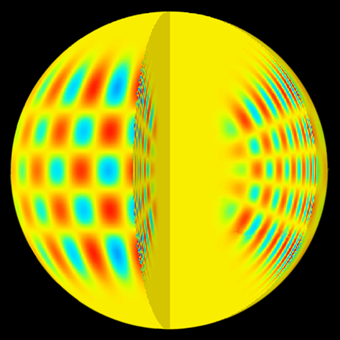
    The sounds of the internal oscillations of the Sun can be heard here and at "Solar Sounds" . Both are linked from a containing article, "The singing sun".


    They are not true natural sounds because they are sped up, filtered, looped and God knows what other nameless DSP alterations were visited upon them. But they more than fit the "natural music" category - definition of which is very liberal on my parts since I consider whale sounds, birdsong, waterfalls, rain thunderclap and surfs (even urban cacophonies) as "natural music".

    But I hadnt had a problem adding them to the "natural music" library under its own "astrosounds" and "space sounds" library. (The first track in the space sounds lib was the recording of the Cassini-Huygens mission's Huygens probe parachuting down on the Saturn's satellite Titan.)

    Leaving aside for a moment their grand natural splendor, a an amateur synthesizerist, these sounds psyched me the curry out something wicked.

    The low numbered and separated modes recording sounds make very interesting clear waveforms in their own right. (example)

    Recording where numerous oscillation modes are present (example recording), the sounds as waveforms are literally "out of this world" and a great find for waveform samplers and tinkerers. In addition to a lively TVA and TVP "program", terms come to mind like Rich multilayered textured and (in a timbral/spectral sense) very colorful!

    Other celestial objects also have audio signatures / recordings worth hearing (and using) e.g.. ... Read more

    group terms - interim


    Source code can be seen by clicking on [pagesource] at
    http://augmented5th.dyndns.org/doku/doku.php?id=math_object_graphs ... Read more