17 November 2008

draft notes to the student

  • Seek a good teacher. For several reasons. Self-study is only good up to a point, beyond which, an experienced mentor is required to dispell confusion and misunderstandings, as well as to advise on the proper curricular course. Otherwise much time can be wasted, understanding mangled, and learning not achieved. There is no substitute in learning for the experience of the expert teacher. In the Yi Jing it is written , "Whoever hunts deer without the forester. Only loses his way in the forest." (Hexagram 3 屯 Chun , Difficulty at the beginning, Difficulties). The good teacher crucially protects from being exposed to matters for which the student is not ready. Exposure to some subjects without proper preparation risks losing first impressions to misconceptions or other barriers to comprehension, necessitating a laborious repair.


  • texts,understanding: sometimes it matters more to go through the text even without understanding it, than to go through it only with a full understanding. Understanding also improves with repeated reading of the passage. Here the case is
    where a higher value is placed on developing a familiarity with a given topic,
    rather than fully assimilating its every aspect in text.


  • it helps a process of reinforcement when reading is repeated later with new information


  • sometimes, by itself, without added information, understanding seeps in with time.


  • rote: repeated reading helps learning by rote (by heart, 7ifzh).


  • Anecdote says that the tax of learning is teaching it. Igws that good science should be shared. The sharing and imparting of truth is of general benefit.


  • text,understanding: repeated reading helps understanding a great deal. Revisiting a book after some time with or without accumulating new knowledge sheds new light on the subject.


  • problems: "if you cannot solve the problems in the text you've studied then you've learned nothing." <- wish i could remember where i saw that. Problems are a key ingredient in physics and math texts and many of them present new theorems corollaries , applications etc.


  • The student should fulfill one's end of the pact with God. The pact is by default already there, built-in, and always redeemable on the part of God.


  • texts,pedagogy: on a given subject, the texts and discourse from different academic cultures (countries) offer different perspectives. For example compare the standard description of the Pauli exclusion principle common in English textbooks, with its counterpart in the Russian ones. As another example compare the kinds of problems presented in curricula for college-level Calculus I and those found in American textbooks and presentations.


  • Thus while a subject like physics is the same enabling germans and others to develop quantum mechanics that agree with formalisms developed by englishmen, there are still important differences in pedagogic approaches and in the explanations and descriptions given of the same phenomena.


  • God provides insight, understanding, discoveries , new directions or things that suddenly come into view, and is the provider of all the tools and aspects of learning. He enjoins and accepts supplications petitions and requests , and such we should turn to him for advancemnt utility and benefit in one's science.


  • texts: In some cases, looking up references in unknown languages (even in unknown writing systems) can offer non textual information such as formulas in standard latin notation that would be missing from other familiar texts, or in diagrams, schemas, and other visual or nontextual information, particularly with video or other graphic media.


  • problems: visualize the problem [Tipler]; analyze problems geometrically [Mandelbrot].


  • study,environment,discipline: scholarship is greatly served by a healthy physical regimen in sport and nutrition. in the few times that system was on , studying was a lot better.


  • from Zosimos who also recommends nighttime work: celibacy. The lack of it may have an adverse effect on intellectual spiritual and magickal power and prowess.


  • study: study work and mental focus is of a better quality at night time. a reversal of one's biological clock is unhealthy however . A workaround is to wake exceedingly early , and to redistribute sleep to two sections earlier on in the evening. Thus sleep a little after dusk and wake up around three in the morning , or between that and four; a good third of the night before dawn, the last third. It is during this time that both spiritual and scholarly work are most amenable. Particularly spiritual. As the scholarly work can then extend into early morning. Indeed as many would agree, early morning study is the best in terms of quality and clarity. This , coupled with quick review before sleep in the evening , would assure hasty arrival at the student's goal. ... Read more
  • about theorem graphs


    **notes about graphs**

    * The connections in the graph represent links that generally fall into the
    following categories:
    * pedagogic links (similar to object graphs, often but not necessarily
    coincide with structural links, best suited for syllabus organization)
    * structural links (object graphs, formal repartition of connections among
    objects properties and operations).
    * logical links ( -> theorem paths , do not coincide with object graphs)
    * historical links (do not necessarily coincide with theorem path graphs)
    * a variant of this is a full historical graph , where new types of nodes
    are used to represent persons who contribute to theoretic development,
    writings and other research artefacts, and a timeline.


    * Of the different kinds of graphs, some stand out more :
    * __**1. Theorem path graphs:**__
    * show how axioms lead to theorems and how the latter lead to more theorems.
    * they also show how different concepts or formalisms lead to different
    theories and where a given theory is situated with respect to other
    theories, in terms of "lead to" relationships and influence, or borrowed
    concepts and formalisms.
    * These graphs also often coincide with the (actual) historical developmental
    sequence of the theories shown.
    * This can be emphasized using a time line with actual dates or year dates
    to highlight the historical sequence of developments.
    * Nonetheless theorem paths are not always ordered in historical sequence, and
    should be distinct from historical graphs for this and for other reasons
    * eg, historical graphs also use person nodes, which are not always needed
    or desirable in theorem path graphs.
    * Theorem graphs are particularly useful at the high level, where inspection
    shows interdisciplinary connections and general paradigmatic and formalism
    developments in mathematical or physical theories.
    * __**2. Object graphs:**__
    * These should reflect the basic notion that mathematical objects or classes
    of objects (and by extension mathematical theories) are synthesized from sets
    and a set of properties and for which certain operations are defined which
    are often maps.
    * in the case of object graphs, The drawing itself,is a structuring process
    that reflects the structure of the mathematical or algebraic theory.
    * akin , though in a less formal way, to object-oriented class diagrams.
    The main difference is that common operations and properties are listed
    separately from classes. Also, object graphs do not have to include
    object maintenance and communication patterns found in OO class diagrams.

    * aesthetic note: our philosophy regarding the choice of graph colors (color
    styling) is sabr aghwar el-blandness.

    * graph examples - all are snippets :
    * theorem_graphs
    * object_graphs
    * historical graph.
    ... Read more

    The planet of seas

    One thing to notice about the world, or nature , is abundance.

    Though I once in derision called our home planet, blighted as it is by our human mass stupidities of choice , the planet of apes, in more general terms one might as well call our planet (by which I include its different superposing spheres: the biosphere , the culturesphere , the cybersphere and so on) the planet of seas, or an ocean planet.

    In any domain be it natural or speculative, one is confronted with an abundance of detail and of substance.

    Every taxonomy, and every subject catalog contains more than we can incorporate. In every field is more information and discourse than one could ever want to learn. The phrase that often comes to mind when exposed to the vastness of information in any given field of human interest , is (at least in arabic parlance) "it is a wide sea".

    These figurative seas, our world overflows with them.

    Even for collectors, usually of artisanal objects from tin cans or stamps to exclusive artwork, paucity is an issue only in the artificial terms of economics and collectors price markets. But taken globally, there is an abundance in these items too.

    This all contrasts with the voices that sound the call on "scarcity". Those voices happen to come, nearly ironically, from the richest corners of the earth. They are our self-appointed experts (perhaps by virtue of their accumulated wealth) on matters of quantity abundance and scarcity. Yet they also appoint themselves regents on the wealth of the world, never allowing too much of it to escape being at least partly under their control.

    Those bugle calls of "scarcity" ring hollower than empty oil drums, however.

    For in this world of immense material abundance , after the most rudimentary of physical surveys one scarcely finds anything more abundant and more ubiquitous in nature than energy. Right down to the nittiest grittiest littlest confines of nature , there appears nearly a limitless flow of energy.

    Indeed it should strike us as an astounding shortcoming and failure on our part that we have so far found no better way to convert or redirect the abundance of energy surrounding us, than to burn fossil fuel.

    So there are two possibilities here. Either it is the case that we , while we like to prize ourselves on our "technological achievements", are in fact monumentally stupid. Or, alternatively, our technological shortcoming when it comes to energy is willful, in the sense that it may be a symptom of a sort of generational hegemonic agenda that seeks to spread the notion of scarcity as a means of controlling the flow of the world's resources - in the process sustaining self-enrichment while needlessly and stupidly impoverishing the vast majority of the world's population.

    If this were the case, then the false prophets of "scarcity" are not only fear-mongering and disinformationists but also war-mongerers.

    Getting over those morons (or bastards) for now, what need concern us more , however , is that in the innocuous observation of abundance of things in our world, we find an overwhelming abundance of energy.

    I am (not almost but fully) certain we can tap into it without recourse to the traditional methods of "dirty" energy.

    I'd like to take advantage of the present ephemereal zeitgeist in the cybersphere of "yes we can", to sound a consonant note regarding our potential to cleanly tap unprecedented amounts of energy (i don't know how (;;) but what is clear is that there are tons of it lying all around us in the form of various potential fields). ... Read more

    16 November 2008

    oxymoron

    this word is of itself an oxymoron.


    per·spic·u·ous
    PRONUNCIATION: pr-spky-s
    ADJECTIVE: Clearly expressed or presented; easy to understand. ... Read more

    note regarding group theory

    ... Read more

    mathematical object graphs


    Object graphs should reflect the basic notion that mathematical objects or classes of objects (and by extension mathematical theories) are synthesized from sets and a set of properties and for which certain operations are defined which are often maps.

    Also, in the case of object graphs, The drawing itself, or expression into a graph , is a structuring process that reflects the structure of the mathematical or algebraic theory.

    this is akin , though in a less formal way, to object-oriented class diagrams. The main difference is that common operations and properties are listed separately from classes.

    Of course the real major difference between theorem graphs and class diagrams is that both exist for different purposes: while the former ends up as a (hopefully interactive) visualization, the latter gets implemented as software.

    Thus theorem graphs will not have to contain patterns for communication and maintenance of classes of objects.

    Nonetheless a formal mapping from math object graphs to class diagrams could be highly desirable unless completely covered by the presence of such object libraries.


    Example of a couple of group theoretic objects
    ... Read more

    15 November 2008

    about the so-called Turing test

    I always found odd that the proposition that a human judge a remote teletext communicator on human terms was anything less than obvious and a non-thought. For if it were so obvious then why bother giving a name and attributing it only to one person?

    D'ailleurs, the notion itself raises several problems:

    - One of the most pressing problematics is that the Turing test asks the testor, or subject to lie to themselves. This is the case when a person knowingly engages a machine in order to evaluate its Turing test passability. Judging the remote communicator against different human appraisal criteria becomes much akin to proofs by contradiction and is thus nonconstructive at best. In other words, it helps none in defining formal distinguishing patterns separating menschen and machines.

    - As noted earlier , the Turing test fails to pass an idea of a test (a real one this time) where lack of autonomy should be one of the first signs that the remote interlocutor is a machine not a mensch.

    - Another problem is the undue emphasis placed on this non-thought , in the form of things like the Loebner prize raising the problems discussed earlier on.


    In the end, it is fortunate that with the kind of application we are interested in and which define AI for us we don't care about the notions of the so-called "Turing test". ... Read more

    can AIML an expert system make?

    The way AIML is structured, primarily for dialogue engines, appears (though still untested) to be very amenable for the productio rule structure of an expert system.

    The question really is whether AIML would be sufficient to use in making an expert system. How malleable would it be for the synthesis of production rules using primitives available in AIML and its extensions?

    Luckily there are some interesting "knowledge" oriented structured datasets such as ontologies and taxonomies lying around that could be used to try to answer these questions by attempting a rudimentary AIML production rule system. ... Read more

    13 November 2008

    todo: next quantum steps

    With the ability to decipher the mathematical outlines of modern matter theory, the next steps are to revisit some recent motivations (1990s) for that endeavour:

    - QUIT: explore QUantum Information Theory issues such as
    - update to its consequences in computer arch and communication;
    - revisit notions of remote entanglement and decoherence on which QUIT is based.
    - is "communication" by entanglement/decoherence really channel-less?
    - if speed is relativistic, then is it affected by material media like c?
    - revisit algorithms of Shor, correction codes , cnot circuits, etc., hopefully better equipped this time 'round.

    - GUT: how gauge invariance formalisms lead to the competing unification theories such as quantum loop gravity, symmetry breaking and string , membrane and M theories.

    It is also time the satirist's history of quantum mechanics was revisited. ... Read more

    06 November 2008

    mathematical prerequisites for gauge theories


    where yellow box = theory , and green ellipses=objects.

    Information in the above is from the two texts,

    George Svetlichny, "Preparation for gauge theory", arXiv:math-ph/9902027v3 12 Mar 1999. (a quick review).

    Aitchison & Hey, Gauge Theories in Particle Physics, Volume 1: From Relativistic Quantum Mechanics to QED, Third Edition, CRC Press, 2002.

    From a theoretic-organization perspective, a different graph is needed, an abridged draft of which is shown here,


    p.s. From a graphing perspective, the top graph contains the information content of only about a minute's worth of reading. Which unfortunately does not bode very well for the general utility of theorem graphs considered in an earlier note. ... Read more

    04 November 2008

    Theorem graphs

    Theorem graphs are as useful as text in conveying information on the mathematical or theoretical subject being studied.

    There are several types of graphs or graph categories and an application is needed to let users manipulate those graph category to cover a particular theorem , theory or field of study.

    Such an application should enable users to select what types of graphs they want to view or update (edit)

    as well as to view more types of graphs at the same time

    The ability to zoom in and out navigate edit and update the graph

    Zooming should be implemented both
    a) visually (the familiar zoom in out scaling)
    b) and structurally by the ability to "collapse" a group of nodes or subgraph (if the subgraph is collapsible) into a single node and to expand a node to a collection of nodes or subgraph , if the node happens to be "expandable".

    This enables the user's navigation across layers of abstraction or layers of detail, and lower level of the theoretic body.

    The graphs should cover a wide range of fine-ness , from the most general, broad label, type graphs ,

    to the very fine structure of the elements that go into a definition or a theorem.

    In the limit, a theorem graph should be able to "graphize" even the elements of a proof of a theorem, through a combination of logic and object graphs.

    The Types of graphs:

    object graphs: where
    nodes tend to represent
    - entities , such as sets and sequences
    - operations, such as binary relations or maps (eg, functions)
    - properties, such as linearity, commutativity
    edges to to represent a relation of the type "this goes into this, or makes up this"
    more formally, the child "has" the parent property or relation or set

    logic graphs
    where emphasis is on meanings of edges, which include:
    parent proves child
    the edges represent a sequence of steps in a proof, with the ultimate node being
    an enunciation of the theorem
    There is still some ambiguity on the choice of what nodes are to represent.
    They can represent steps in a single proof , in sequence ,
    where each step is node


    historical graphs
    nodes include
    writings
    persons
    experiments
    date node: plaintext nodes with "year" labels connected by invisible edges to make a timeline, as seen in the old unix
    history dot graph.

    Nodes also include
    definitions
    theorems
    hypotheses , conjectures, etc.
    theories : more general than theorem, and generally correspond to a distinct field of study as well as part of a theoretic framework

    Edges in historical graphs often denote "contributes to" as well "leads to"

    Because there are different categories of graphs, the user should be able to switch graph categories on and off according to their convenience.

    In a historical graph, a user should be able to click on a node for a given theorem, and thus expands a subgraph which in fuller detail, shows the user depending on his choice, either the object or logic makeup of the theorem or definition.

    Examples with static graphs and more notes can be found at math_graphs. ... Read more

    film r-vu draft: Wall-E

    Wall-E actually programs the young to fulfill the horrifying dystopic visionin the film.

    This is the price of wanton emotional manipulation of kids by misanthropes.

    The price is life on Earth and humanity.

    Thus viewed the quirky pitch modulations of the robots' voices take on a very sinister frightening quality. ... Read more

    03 November 2008

    chatbox dead giveaway

    The Loebner award recognizes that the bots it rewards as most life-like do not pass the Turing test.

    But there should be a dead giveway they would not pass the Turing test, without even having to do the test. I am almost certain the prize participants are aware of it because it would be an astounding shortcoming if they are not. On the other hand if they are aware of it, why haven't they rectified it and fixed the problem? And if it is not fixable, then why bother with the Award program at all?

    ------
    four chatbots:

    * http://www.elbot.com/
    * http://www.icogno.com/joan.html
    * http://www.pandorabots.com/pandora/talk?botid=f5d922d97e345aa1
    * http://www.jabberwacky.com/
    ------

    The chatboxes or bots listed above lack the notable feature we should from anything that would pass the Turing test: autonomy. The bots mentioned are all only event-driven. Without any input from the user, they do nothing.

    At least Elbot recognizes blank inputs, but without any input from the users , blank or not, these four bots are dumb.

    As autonomous agents, humans have the potential to talk almost endlessly along coherent lines of reasoning. Being self-motivated, they have the ability to pick subjects, organize ideas and reasoning about them, probe past memory for things they might *want* to remember to mention. All these things contribute to the shape forms and usage of natural language, to the way natural language sounds to it.

    Without this dimension, no matter how funny or witty the hardcoded responses thought up by the authors are, there's a very obvious dead endedness or closed quality to the chats.

    As if this weren't enough, there is furthermore another difference from human conversation. With these chatbots, the speech responses are alternated between the bot and the user , in a ping pong fashion. In human conversation, it is customary to be interrupted, sometimes ignored, sometimes responses are formed that are spoken over your message, and responses occur in real time as the two parties speak at the same time. In human chat situation, there is no such articificial synchronized input - response sequence. Chatters often type at the same time, sometimes inputs or queries receives other queries as a response due to this lack of synchronization between the speakers.

    As a further aside there is also the question of whether and how does XSL and XML deal with temporal reasoning ? If not this could present a possible limitation to the ability of AIML to handle complex reasoning tasks. There are extensions however, and example of where extensions enabled the synthesis of elements like conditional responses, as outlined in t

    One of the conclusions is that how can all this be known by the Loebner prize people and yet they proceed with so-called Turing tests. Doesn't the foregoing mean a failure even before the Turing test is started? An a priori failure by default. The conclusion means that the Loebner Prize is really a joke, that the effort is not well-guided, that it simply rewards the wit of funny responses and cute avatar graphics.

    That is it takes things like videographic and speech synthesized chatbots as advances, whereas they are only windowdressing with real substance missing and omitted.

    The pretentiousness of participants (those that apply for the prie) then is thus clear. They know they are not Turing test worthy, and yet they join just to get cutesy awards of "most human-like". This constitutes a joke, a sham, a waste of time, mock AI. Not AI.

    P.S. - 19.xi.08 - Come to think of it, even the name of AIML (which i think was dev'd by Alice' folks) is unfortunate. Maybe W3C should 've copyrighted the use of the partial-acronym ML (just kidding; I'm all for memetic freedom and all). It's certainly an ML, this AIML, but it's *not* AI. At least it is not all the AI there is, if i'm not misunderstanding anything. Even if i'm misunderstanding all the possibilities of AIML, it's still an application within the linguistic or reasoning school of AI (ultimately relying on a von Neumann machine), and not of the connectionist or genetic or distributed paradigms (to say nothing of new AI algorithms for quantumputers - hopefully exploiting other than just massive parallelism). ... Read more

    collective unconscious wants gopher

    My first encounter with the Internet was via Gopher ca. '91 - '93. I noticed its yielding of relevance to HTTP even before the Internet Commercialization Act of 1995, and more assuredly so afterward. Nostalgia however kept "gopher" hovering in the cloud way in the back of the mind. A couple months ago, I started getting an itch to look up gopher on Wikipedia in anticipation of finding where there is still access.**

    Well, after zoning out of the idea every time it hit me when i'm busy over the past two months or so, I looked up gopher at wikipedia.

    ** There was anticipation because of course there must be access to Gopher still (it's been made GNU GPL anyway, i thought it had always been "open"! but it wasn't) as there are NNTP servers. Because there always should be NNTP servers and every TCP/IP App layer protocol should be kept. This must be contentious for a lot of design thinking where comprehensive backward compability is irrelevant, costly and therefore ridiculous. But I mean we're talking client server protocol implementations that should be tiny (in text and data (mem) complexity), not hulking 3.5'' drives (not to mention 5.25's and tape readers :)), right?

    So keeping as many of the useful proven RFC's (ie their protocols) alive is historically cool, maintains diversity in the design idea pool and the variety of media for the choosy / nostalgic users who choose nothing better to do than to write about it like this.

    In any case, looking gopher up , I read (this being a recurrent pattern btw) that it so happens there is at present increased interest in gopher: "As of 2008, there are approximately 125 gopher servers indexed by Veronica-2,[8] a slow growth from 2007 when there were fewer than 100." (ibid.)

    So once again, it seems that an idea (in this case the rekindling of interest in gopher) was not just appear here only but instead it was non local, generalized, occuring in several instances more or less in a short interval of time (say the span of 2008 - in my case through late summer and fall). ... Read more

    01 November 2008

    space age is here

    Space age is here when every few months we run into people putting appearances in helmets, but rather very cool helmets.


    Of course tons of vectors lead up to it, from mountains of scifi, to the emerging universal bashfulness all of a sudden with everybody hooded in news footage, to the possibility those helmets comment on that. That bit particularly is doctrinal shit. It's a counter counter counter cou- hey that's my tail i been trying to catch .

    Back to the helmets:

    Nobody's helmets are cooler than Daft Punk's. If their music weren't cool they could probably eke a living just pimping those cool helmets. I'd seen their photos before, but early this year, I Ran into this photo when Facebook launched fan pages. Theirs was among the first. copyright copyright. yes the image is the copyright of "them" the owners of the copyright, which is linguistically redundant.


    Not much later on, sprucing up the late summer news cycle, shenanigans of a certain Anonymous landed me on youtube watching one of his/their videos, from which was taken this snapshot with the helmet really stealing the show.


    Speaking of which, is the whole Anonymous mystique is a sort of experiment in social dislocation by something like "RAND Corporation: The New Generation" ? nothing is impossible, :) particularly this sort of thing.


    Later on the helmet got surreal beyond human comprehensibility.


    Rather anticlimatically, finally my latest encounter was a couple of days ago when I saw the a thumbnail of the picture below at news.bbc pointing at some TV awards pics. The photo is of The Stig, a race driver & presenter of brit automoto TV program , Top Gear, getting an award. Ne'erheardo'im. But he's the Stig. new generation of racing,
    helmet always on. day and night.


    Meanwhile android designers have been taking to the human look of late,


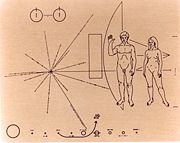
    I think such similitude is as ridiculous as the plaque sent with Pioneer craft in the 70s.


    which brings us back to that the space age is here. ... Read more